Showing posts with label gemstones. Show all posts

Wednesday, June 6, 2007

Designer Handcrafted Jewelry: From Idea to Reality


Design Sources


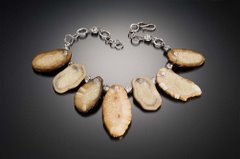
People visiting galleries, art shows or boutiques often wonder how designer handcrafted jewelry is created. They often ask, "Where do jewelry designs come from?" or "How does the artist design this jewelry?" In fact, many artists cannot tell you exactly where designs come from, but they can share how they go about designing jewelry. There are as many different approaches to creating designer handcrafted jewelry as there are artists working. Some artists have a predetermined style or a "branded look" with specific stone combinations or techniques that give a starting point for their designs. Other artists create commissioned pieces where the design marries the specific needs of the client with the specifics of an existing piece of jewelry. Perhaps the most challenging for artists is to start a design from scratch. Luckily, most artists will say that inspiration is all around them, all the time. They simply have to be aware of the visual resources around them every day. Whether it is the exquisite colors of tropical lizards, the wavy wrapping of a bird's nest, the mechanics of a doorbell or shaped and patterned seashells, the rhythm, color and patterns usually spark creativity and the beginning of new designs. Even when artists use similar design sources, that does not mean they will produce the same jewelry product. Two artists using a butterfly theme or motif as their inspiration will generate two quite different jewelry solutions. A butterfly theme may become a brooch encrusted with colorful, faceted gemstones or it may be created from fine silver, then hammered to create relief and patinated with chemicals to create a dark, rich metallic surface. That is why designer handcrafted jewelry is so intriguing.

Design Elements


Looking at the finished product, people often wonder how artists know if a piece has good design. How do artists decide what designs to use? Line, shape, color and texture are basics that most artists consider when designing jewelry. They also consider whether the piece has contrast, balance, symmetry/asymmetry, a focal point, and proportion. Sometimes the void or the space not filled up, called negative space, is the most important aspect of a design. Artists usually view the piece from many different angles, even upside down, to more easily analyze and isolate the different design strengths or weaknesses. Whether a piece conveys a feeling or mood or how well it functions is also considered at this design stage. Necklaces that are imbalanced, clasps that are uncomfortable on the neck, rings that are too thick between the fingers are issues that artists must resolve when designing. And of course, there are many different techniques and jewelry processes that can also determine the overall look and feel of jewelry. Forged metal may focus more on line and movement but not color. Texture can be created through hammering or milling. Relief can be created through repousse work or granulation. To create dynamic pieces of jewelry, the piece will have good flow and cause the eye to move all around it. To discover the best of many alternatives, designers have to explore or at least be aware of all the options open to them and then select those that will create the most interesting and beautiful piece.

Fingerprints


The best designer handcrafted jewelry is "fingerprinted"; that is, it bears the mark, the unique look and feel of the artist who created it. As jewelry designers focus their artistic techniques and hone their eye to visual themes, they will develop a completely individual style or "brand" that can often be identified by others. This is the goal toward which designers strive. Sometimes what begins as a mistake, a torch melts the edge of silver, or a patina goes darker than expected, can be a point of departure for an artist who wants to develop this branded look. That which was a "mistake" can become a new method of working with a particular media and then, in turn, become a distinguishing look of the artist's pieces. Todd Reed was one of the first to use unfaceted, rough diamonds in his work. Charles Lewton-Brain was one of the first to develop the techniques and unique look of fold-formed silver as a metalworking technique. Many well-respected jewelry artists today, who exhibit their work in fine galleries or sell their jewelry in fine craft shows, have one or two distinguishing elements to their work.

All designs of true jewelry artists are original, not just copied from something or someone else. By understanding and using the elements of design, the artists can purposefully change their original inspiration or starting point into a totally new creation. There are no real design "rules". Designer handcrafted jewelry is attractive and timeless because the artist who creates it has successfully used visual resources together with highly skilled techniques to create the one of a kind or limited edition pieces for which they are known.




Thursday, May 10, 2007

Common Is Beautiful ~ Poppy, Picasso and Paintbrush Jasper Gemstones


Picture Jaspers

If you were walking on the desert or hiking in the foothills, what would you do if you came across and amazing stone that had large yellow and red spots that reminded you of your garden poppies at home? You would probably want to name the stone “Poppy Jasper”. That’s what rock hound enthusiasts have done for years. The names Poppy, Picasso Marble, Dalmatian, Paintbrush, Rain Forest and Leopard Skin are all names that describe the large group of jasper know commonly as “Picture Jaspers”. Dalmatian Jasper is white with black spots while Leopard Skin Jasper is beige/pink with spots of black and yellow, resembling Leopard Skin.

Picture Jaspers have amazing colorations and designs. Jaspers are found in colors including red, brown, pink, yellow, green and shades of blue and purple. The organic material and mineral oxides in Jasper create interesting patterns. Because of the foreign materials, jasper is rarely uniform in color but commonly multicolored, striped or spotted, bands and colors. Many of the patterns resemble landscapes with mountain and valleys, so the name “picture” is part of the name of many well-known jaspers. One of these famous jaspers is Morgan Hill Poppy Jasper. It is jasper with red and yellow dots that resemble poppy flowers. Technically, it is brecciated jasper, meaning that it came from sun-dried and oxidized iron-rich clay; the cracks were then later filled in by other substances.

Place Name Jaspers

Although jaspers are found worldwide, a wide variety of named jaspers are found in the western areas of the United States. California, Oregon, Idaho, Utah, Wyoming and Washington are well known for the place name jaspers such as Stone Canyon Jasper with its mustard yellow base and cream and purple banding. Others are Willow Creek, Owyhee, and Deschutes Jasper. Other popular jaspers are found in Germany, India, Russia, Pakistan, France and the USA as well as many other countries

Magical and Therapeutic Jasper

Jaspers have been to about every culture known to man. Many of these cultures have attributed magical powers to Jasper. Native Americans believe that jasper brings rain and in fact, the word for Jasper in some Native American cultures meant “rain-bringer”. Jasper was also used in Ancient European times as a "rain bringer".

Natural healers consider jasper useful as on overall healing gemstone. Wearing jasper was believed to provide protection, have a calming effect and give stability and security. It is thought to balance one’s physical, emotional and intellectual states.

In folklore, Poppy Jasper is thought to function like adrenaline, waking up and energizing areas of the body that appear to be sleeping. It is believed to encourage a deep connection with the life of the Earth. It inspires a positive, joyful attitude and gives the motivation and energy to take creative action. To natural healers, poppy jasper is a gemstone that was broken and healed. They consider this a very useful gem to help with blood disorders and heart problems. Poppy Jasper is also thought to enhance strength and willpower.

Storytelling

The folklore and cultural history surrounding Jaspers adds to the beauty of these amazing stones. Picture Jaspers could certainly inspire creative story telling and belief in their curative properties. Their beauty can be explained in geologic terms, but their colorful designs inspire and ask for more creative explanations. Jewelry designers often utilize the beauty of nature with its abundant color, pattern, shapes and forms, as original sources of inspiration. When visualizing new designs, artists will often create a "story" or a theme that helps to bring forward the passion or inspiration for a specific piece of jewelry. Then the piece is not just a necklace or bracelet but adornment to enhance the wearer.


Monday, May 7, 2007

Emerald | May's Birthstone

Emerald ~ May's Birthstone

Most gem historians believe that our ancestors regarded gems as sacred gifts from the heavens and that emeralds specifically carried magical powers. Some legends said that you could see the future if you held an emerald under your tongue. Others stated that emeralds would bring riches, power, strengthen memory and intelligence, reveal the truth and help to avert evil. Other cultures associated the gem with faith, harmony and peace. Emerald history and lore is unique and rich.

The idea of birthstones, specific stones for each month of the year, has also been around for thousands of years. May, the fifth month of the calendar year, has Emerald as its birthstone in Western tradition. It is also the May birthstone for the Arabs and the Hindus. Mercury is the planet that rules the Emerald and other green stones according to Hindu astronomers. Mercury, and therefore Emerald, rules the mind, intelligence and affects a person's ability for public speaking, education, and travel. Other birthstones for instance are Amethyst for February, Pearl or Alexandrite for June, or Turquoise for December.

Who Decided?

Some people theorize that the earliest associations between gemstones and months of the year evolved from the twelve stones mentioned in the Bible, while others attribute the development of the birthstones to the Twelve Apostles. And yet, still other religions have produced quite different beliefs as to the origins of birthstones.

Better means of gem identification, more modern interpretations of various religious writing, and various transformations in world have played into the evolution of the birthstone idea. Finally, in 1912, in an effort to resolve this issue, the American National Retail Jewelers Association decided on a list of birthstones. They added or changed many of the traditional stones to other which were more commercially viable. In 1938, the American Gem Society adopted this list for use by its members. In 1952, a variation of this list was approved by the American national Retail jewelers Association and the American Gem Society. This official Western list of accepted birthstones was established at least partially on the basis of maximizing sales and profit.

However, other groups around the world have issued their own lists. Alternative birthstones lists are based on cultural traditions and religious beliefs that evolved over many hundreds of years. These cultures assign any or all of the following gemstones as May birthstones: Agate, Carnelian, Chrysoprase, Garnet, Jade, and Tourmaline.

Emeralds and Modern Science

Like our ancestors over many thousands of years, many people today believe that birthstone jewelry can improve health, confidence, relationships, consciousness and finances. Those who believe in metaphysical principles or those who practice astrology say that the planets and all the stars in our universe emit magnetic and electrical fields, a fact confirmed by modern science. In addition, they say that each planet gives out its own cosmic color and generates a particular energy and influence that radiates throughout the cosmos. The energy properties of heat, magnetism and electricity have an influence on the life of every living creature.

They believe that gemstones which resonate with the planetary energies active at the time of one’s birth, can diminish negativity and enhance positive energy in one’s life. Rather than a single gemstone for your birth month, there may be several that resonate with the specific energies active at the time of your birth.

For ancient Egyptians, the emerald’s color symbolized life itself. The French word 'jardin' (zhar-dan) means garden and it is often used to describe the ‘inclusions’ in emeralds. If you look at an emerald under a microscope, the inclusions appear as luxuriant foliage. Emeralds are one of four precious stones, along with diamonds. Whether you believe that Emerald or another gemstone is the best May birthstone, the history and lore surrounding any gemstone can be fascinating!

Wednesday, May 2, 2007

Thunder Eggs and Lapidary Roots

As a jewelry designer, selecting top quality gems, cabochons and beads for jewelry designs is an exciting process. I often talk with the “middle men”, the vendors who obtain these beautiful components. But I also have reverence for all those who have mined, sorted, cleaned, rough cut and then polished exquisite gemstones before I select them for a design.

I have often thought that to be “authentic” (a descriptor for my favorite people), one must walk the talk. To really understand the journey and history of any gemstone, a designer should at least once, search for gemstones in dusty places, cut with diamond saws, and use lapidary polishing equipment to get a behind the scenes look at what it takes to produce jewelry-ready gemstones.

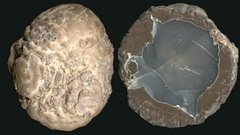
I have been attending a lapidary seminar to extend my “front line” knowledge of this part of the jewelry world. Last night involved cutting and polishing a “Thunder Egg”. Though I will not be able to use this stone for jewelry, I enjoyed the opportunity to tap into my natural “roots”, even though I am an urban dweller.

Because it is such a delightful story, here is how the famous “Thunder Eggs” of Oregon came into being. According to ancient Native American legend, when the Thunder Spirits living in the highest recesses of snowcapped Mount Hood and Mount Jefferson became angry with one another, amid violent thunder and lightning storms they would hurl masses of these spherical rocks at each other. The hostile gods obtained these weapons by stealing eggs from the Thunderbirds' nests, thus the source of the name "Thundereggs."

A Thunder Egg is like a filled geode, the outside is often Rhyolite and the inside an Agate. Well this week Thunder Eggs, maybe next week I will move on to Amazonite, Labradorite, or even Amethyst. Though my primary work is design and fabrication of silver which incorporates gemstones, I am thoroughly enjoying this trip behind the scenes.