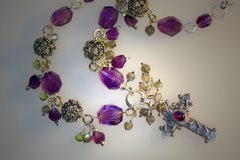
Design Sources
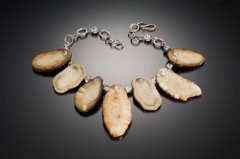
People visiting galleries, art shows or boutiques often wonder how designer handcrafted jewelry is created. They often ask, "Where do jewelry designs come from?" or "How does the artist design this jewelry?" In fact, many artists cannot tell you exactly where designs come from, but they can share how they go about designing jewelry. There are as many different approaches to creating designer handcrafted jewelry as there are artists working. Some artists have a predetermined style or a "branded look" with specific stone combinations or techniques that give a starting point for their designs. Other artists create commissioned pieces where the design marries the specific needs of the client with the specifics of an existing piece of jewelry. Perhaps the most challenging for artists is to start a design from scratch. Luckily, most artists will say that inspiration is all around them, all the time. They simply have to be aware of the visual resources around them every day. Whether it is the exquisite colors of tropical lizards, the wavy wrapping of a bird's nest, the mechanics of a doorbell or shaped and patterned seashells, the rhythm, color and patterns usually spark creativity and the beginning of new designs. Even when artists use similar design sources, that does not mean they will produce the same jewelry product. Two artists using a butterfly theme or motif as their inspiration will generate two quite different jewelry solutions. A butterfly theme may become a brooch encrusted with colorful, faceted gemstones or it may be created from fine silver, then hammered to create relief and patinated with chemicals to create a dark, rich metallic surface. That is why designer handcrafted jewelry is so intriguing.
Design Elements
Looking at the finished product, people often wonder how artists know if a piece has good design. How do artists decide what designs to use? Line, shape, color and texture are basics that most artists consider when designing jewelry. They also consider whether the piece has contrast, balance, symmetry/asymmetry, a focal point, and proportion. Sometimes the void or the space not filled up, called negative space, is the most important aspect of a design. Artists usually view the piece from many different angles, even upside down, to more easily analyze and isolate the different design strengths or weaknesses. Whether a piece conveys a feeling or mood or how well it functions is also considered at this design stage. Necklaces that are imbalanced, clasps that are uncomfortable on the neck, rings that are too thick between the fingers are issues that artists must resolve when designing. And of course, there are many different techniques and jewelry processes that can also determine the overall look and feel of jewelry. Forged metal may focus more on line and movement but not color. Texture can be created through hammering or milling. Relief can be created through repousse work or granulation. To create dynamic pieces of jewelry, the piece will have good flow and cause the eye to move all around it. To discover the best of many alternatives, designers have to explore or at least be aware of all the options open to them and then select those that will create the most interesting and beautiful piece.
Fingerprints
The best designer handcrafted jewelry is "fingerprinted"; that is, it bears the mark, the unique look and feel of the artist who created it. As jewelry designers focus their artistic techniques and hone their eye to visual themes, they will develop a completely individual style or "brand" that can often be identified by others. This is the goal toward which designers strive. Sometimes what begins as a mistake, a torch melts the edge of silver, or a patina goes darker than expected, can be a point of departure for an artist who wants to develop this branded look. That which was a "mistake" can become a new method of working with a particular media and then, in turn, become a distinguishing look of the artist's pieces. Todd Reed was one of the first to use unfaceted, rough diamonds in his work. Charles Lewton-Brain was one of the first to develop the techniques and unique look of fold-formed silver as a metalworking technique. Many well-respected jewelry artists today, who exhibit their work in fine galleries or sell their jewelry in fine craft shows, have one or two distinguishing elements to their work.
All designs of true jewelry artists are original, not just copied from something or someone else. By understanding and using the elements of design, the artists can purposefully change their original inspiration or starting point into a totally new creation. There are no real design "rules". Designer handcrafted jewelry is attractive and timeless because the artist who creates it has successfully used visual resources together with highly skilled techniques to create the one of a kind or limited edition pieces for which they are known.
 In recent years, silver Celtic jewelry has enjoyed a revival. Men and women prize Celtic jewelry and consider it a treasure among possessions because of its uniqueness in beauty and symbolism. Celtic symbols were evident in ancient Celtic jewelry craft and continue to be powerful motifs even in modern-day jewelry designs. Ornate, symbolic, and enchanting, silver Celtic jewelry was, and still is, highly coveted.
A Rich History
The ancient Celts who settled in Ireland many centuries ago, created enchanting designs in jewelry. Celtic craftsmen adapted ideas from nature to produce intricate designs based on simple motifs in silver and other metals. Silver and gold were used by Celtic craftsmen between 2000 BC to around 550 AD to create ornaments that were remarkably sophisticated. Spirals, animal motifs and later crosses were woven into Celtic rings, bracelets, brooches and pendants.
Celtic Crosses
When one thinks of Celtic jewelry, the Celtic cross often comes to mind first. It had its start primarily in Ireland. Celtic crosses are not just crosses that have Celtic knot work on them. The early crosses were equal-armed crosses, enclosed or backed by a circle. After the introduction of Christianity, it was more common to see the equal-armed cross on a pedestal, which then gave it a more elongated form.
The arms symbolize the four quarters of the earth, or the four elements, earth, air, fire, and water. The Celtic cross represents a bridge or passage between heaven and earth. The circle or center ring is a symbol of infinite love and specifically, the endlessness of God’s love. It is a symbol of eternity and the path of the sun in the sky. Given the spiritual ideas and power represented by this jewelry, it is easy to see why Celtic craftsmen were so dedicated to pristine perfection in crafting the Celtic cross.
This symbol represented the very highest ideals and aspirations of the Celts, and silver Celtic ornaments are among the most timeless. Today, there are literal interpretations of the ancient cross symbols, as well as more contemporary designs with hearts or other spiritual symbols.
Celtic Knots
The Celtic knot ornamental patterns were originally created for the Book of Kells, the best-known source of Celtic knots as well as other types of Celtic ornament. The Book of Kells is a fantastic collection of paintings that illuminate the four Gospels in Latin, written in 800 A.D. The knots were also used in other manuscripts and on monuments. They may have also been used in woodcarving and textiles, but these art works have not survived time.
Celtic knots are a prevalent design feature of silver Celtic jewelry. They are complete loops without beginning or end. It is said that good Celtic artists never leave a loose end on a strand and that pure knots should be unending. Celtic animal designs also interlace like knots, but end with feet, heads or tails.
The Celts dominated Western Europe for a thousand years, but only recently has the importance of their influence on cultural, linguistic and artistic development in Europe been understood. The Celts as an ethnic group disappeared from most of Europe with the exception of Ireland and the Scottish Highlands.
The Celts were well educated in areas such as religion, philosophy, geography and astronomy but transmitted their culture only orally, never writing down history or facts. For that reason, there was little knowledge of their culture before their contact with the classical civilizations of Greece and Rome. Celtic jewelry such as rings, bracelets, pendants, and brooches were so sought after for their beauty and style, that the trade of Celtic jewelry across the Mediterranean was quite successful.
Today’s Artists
For over a millennium, the intricate knot work and minute decoration of silver Celtic jewelry, woodcarving and calligraphy have enchanted the world. Creating new and fresh designs based on classic ancient symbols and motifs, today’s artists are bringing a new voice and interpretation to age-old designs.
 Today there is resurgence in handcrafted art jewelry--artist made jewelry that is created by hand instead of mechanically produced by machine.
Made to 'Perfection'
Mass-produced jewelry often looks more uniform and sometimes lacks the variation that speaks of the hand and eye of the individual artist. Machine made jewelry is produced using pattern and perfect repetition with the focus primarily on profitability. Even though mass-produced jewelry may appear as handmade, that does not mean it was actually handcrafted. Even though mass-produced jewelry of common styles is sometimes less expensive, because less expensive to make, it is not always so. Mass-produced jewelry rarely has special meaning or a history attached to it--it does not have a story or a bit of the maker's life embedded into it.
Handcrafted Jewelry
While machine made jewelry is produced from patterns and consistent repetition, the charm of handmade art jewelry is its variation from similar, but not identically same pieces. Art jewelry shows the creativity, concentration, time, skill and dedication required of the artist to create his/her original. Artists and designers making art jewelry use old metal smith skills, simple tools and a variety of age-old techniques to create new, intriguing forms and shapes. In addition to the craftsmanship involved, art jewelry often speaks or refers to the individuality and personal meaning of the artist as well as their cultural identity and personal themes.
Love and Passion
Handmade jewelry offers the pleasure of unique, often rare designs that are not identical and are created with great love and passion. Art jewelry designers often use natural, high quality materials such as precious metals, precious and natural gemstones, antique components and organic elements such as coral, leather, wood, bone, amber and pearls. They go to great lengths to design unusual, unexpected combinations of shapes, forms, colors and combinations of materials.
Many art jewelers today, have a 'branded' look to their work. The brand may be recognized by the specific collection of materials used, by a highly developed approach to design or to an interesting or unusual technique. Each artist attaches their name to the work and is proud of the reputation they have. For jewelry artists, the creation of new jewelry is a passionate aspect of their life. They enjoy every minute of their work, whether working as the designer or the fabricator or the seller sharing their story with others.
An Art Form
Jewelry is an art form. Painters and sculptors embed their artwork with great strength of feeling that comes through their design process and the finished work. In the same way, art jewelry often reflects the personal touch and style and expresses the individuality and interests of the artist creating it. Many jewelry artists have training in art and design, although others are self-taught. These artists commonly speak about the fascination they have always had in working with their hands. They talk about linking their soul, mind and body together in the process of conceiving a new idea and then creating something new and exciting. Jewelry artists often say that they play with the materials in an imaginary space and then see the materials evolve and transform into components which become in turn, a new form of jewelry. Artists also talk about the silent conversations they have with themselves as new ideas begin to flow and come together for the new piece. They are dedicated to their artistic way of life.
Handmade jewelry is not usually available in large quantities. The attention to craftsmanship and detail is a hallmark of high quality art jewelry. Wearing beautiful handmade jewelry is such a pleasure that it is worth discovering it through galleries or art shows. Sharing and explaining to others the history and information about the jewelry or the story of the artist creator, is a great joy. It is satisfying to wear jewelry that a person has personally and lovingly created with the use of their eyes and hands.